


It's a widely held belief that a company needs a full-time, dedicated Chief Financial Officer as soon as it reaches a certain scale. However, increasingly businesses are finding that a permanent, high-level hire isn't the answer instead, they're turning to part-time CFOs for expert financial guidance. This shift reflects a growing demand for specialized financial expertise without the overhead of a full executive salary and benefits package. As companies navigate complex growth stages, the fractional CFO model is rapidly gaining traction.
This is not a crisis. It is a threshold. And across the past two decades, a quiet solution has emerged at exactly this inflection point: the fractional Chief Financial Officer.
The concept sounds like a compromise a part-time finance executive, shared across companies, without the full commitment of a C-suite hire. But the history of fractional CFO services reveals something more interesting. What began as a workaround for cash-strapped startups has become a legitimate, sophisticated, and increasingly essential category of business infrastructure. Today, the fractional CFO market has grown into a diverse ecosystem offering everything from free self-service directories to white-glove embedded search services.
Understanding where this model came from, how it works, and when it makes sense to engage one is not just useful trivia. It is the foundation for making a smart hiring decision that can shape your company's financial trajectory for years to come.
1. Understand the Problem That Fractional CFOs Were Built to Solve
The story begins with a persistent tension in business growth: the gap between financial complexity and financial capacity.
As Shiny's 2025 guide to fractional CFO firms notes, "Hiring a full-time Chief Financial Officer is a major commitment, often prohibitively expensive and unnecessary for companies that don't yet require 40 hours of executive-level financial oversight per week." This observation captures the core problem that fractional CFO services were designed to address.
For much of the twentieth century, companies had essentially two options when they needed financial leadership: hire a full-time CFO (expensive, often overkill for early-stage needs) or rely on a controller or bookkeeper (affordable, but limited in strategic capability). The middle ground simply didn't exist.
The fractional model emerged to fill that void. Rather than asking a growing company to choose between under-resourced financial management and an oversized executive salary, fractional CFO services offered a third path: senior expertise, delivered part-time, at a fraction of the cost.
According to FlexExec's documentation on fractional CFO services for professional services firms, the model was particularly attractive to "CPA practices growing through mergers, acquisitions, or service expansion" and "management consultancies scaling delivery teams and client portfolios." These were industries where financial complexity was increasing rapidly, but where the traditional full-time CFO hire felt premature or misaligned with actual needs.
2. Trace How the Model Evolved From Niche to Mainstream
The fractional CFO concept did not arrive fully formed. It evolved through several distinct phases, each expanding the model's legitimacy and reach.
In the early 2000s, the model was largely informal a senior finance professional taking on a handful of advisory clients alongside their primary role. The arrangement was often word-of-mouth, relationship-driven, and lacking in standardized pricing or expectations.
The next phase, roughly spanning the 2010s, saw the emergence of dedicated fractional CFO firms. These organizations brought structure to the model: defined engagement terms, vetted talent pools, and clearer service scopes. As the Eightx 2026 guide to fractional CFO services observes, the model now involves "a senior finance executive working part-time across multiple companies on an ongoing monthly retainer, typically 8 to 30 hours per month at $5,000+" a far cry from the informal arrangements of the earlier era.
The explosion of the fractional CFO market over the past several years, as documented by Taylor Crane in the May 2026 Fractional Jobs analysis of the top platforms, reflects broader shifts in how companies think about talent and expertise. The rise of remote work, the normalization of distributed teams, and the increasing acceptance of non-traditional employment arrangements all contributed to the model's mainstream acceptance.
Today, the market offers a spectrum of engagement models. Some platforms function as self-service directories, connecting companies directly with fractional CFO talent for free or low cost. Others operate as white-glove search services, managing the vetting and matching process for a one-time fee. Still others are dedicated fractional CFO agencies that provide talent directly, embedding a finance team or individual executive into client operations.
This diversity is not a sign of confusion it is a sign of maturity. The fractional CFO model has grown sophisticated enough to serve companies at different stages, with different needs, through different engagement structures.
3. Define What a Fractional CFO Actually Does
One of the most persistent sources of confusion in the fractional CFO space is the distinction between what a fractional CFO does and what other financial professionals controllers, bookkeepers, accountants, consultants do. Understanding this distinction is essential for setting the right expectations.
A fractional CFO is not a bookkeeper with a fancier title. Nor is it an accountant who works fewer hours. According to FlexExec's service descriptions, a fractional CFO "provides part-time Chief Financial Officer expertise" and "typically works 10-20 hours per week, focusing on financial strategy & forecasting, fundraising & investor relations, and other strategic priorities without the cost of a full-time executive."
The emphasis on strategy is critical. A fractional CFO's value lies not in the mechanics of financial record-keeping, but in the leadership of financial direction. They are brought in to help a company understand its financial position, plan for growth, communicate with investors and boards, and make strategic decisions informed by financial data.
FlexExec's documentation outlines the core service areas for fractional CFOs serving professional services firms:
- Financial strategy and forecasting tailored to the firm's specific challenges
- Fundraising and investor relations support
- Cash flow optimization
- Financial reporting and compliance
- M&A support for growth through acquisition
- Board and investor communications
These are not tasks to be completed and checked off. They are ongoing leadership functions that require the fractional CFO to become an embedded member of the executive team, even if that team is only part-time.
This embedded quality is what separates a fractional CFO from a consultant. As FlexExec's FAQ explains, "A fractional CFO is an embedded executive who becomes part of your leadership team, typically for 6+ months. Consultants usually work on specific projects with defined end dates. Fractional executives own outcomes and lead teams."
4. Understand the Cost Structure and What You're Actually Paying For
One of the most common questions about fractional CFO services is the simplest: how much does it cost? The answer, like the model itself, has evolved over time and varies depending on the engagement structure.
According to FlexExec's pricing documentation for professional services firms, typical engagement costs fall within the following ranges:
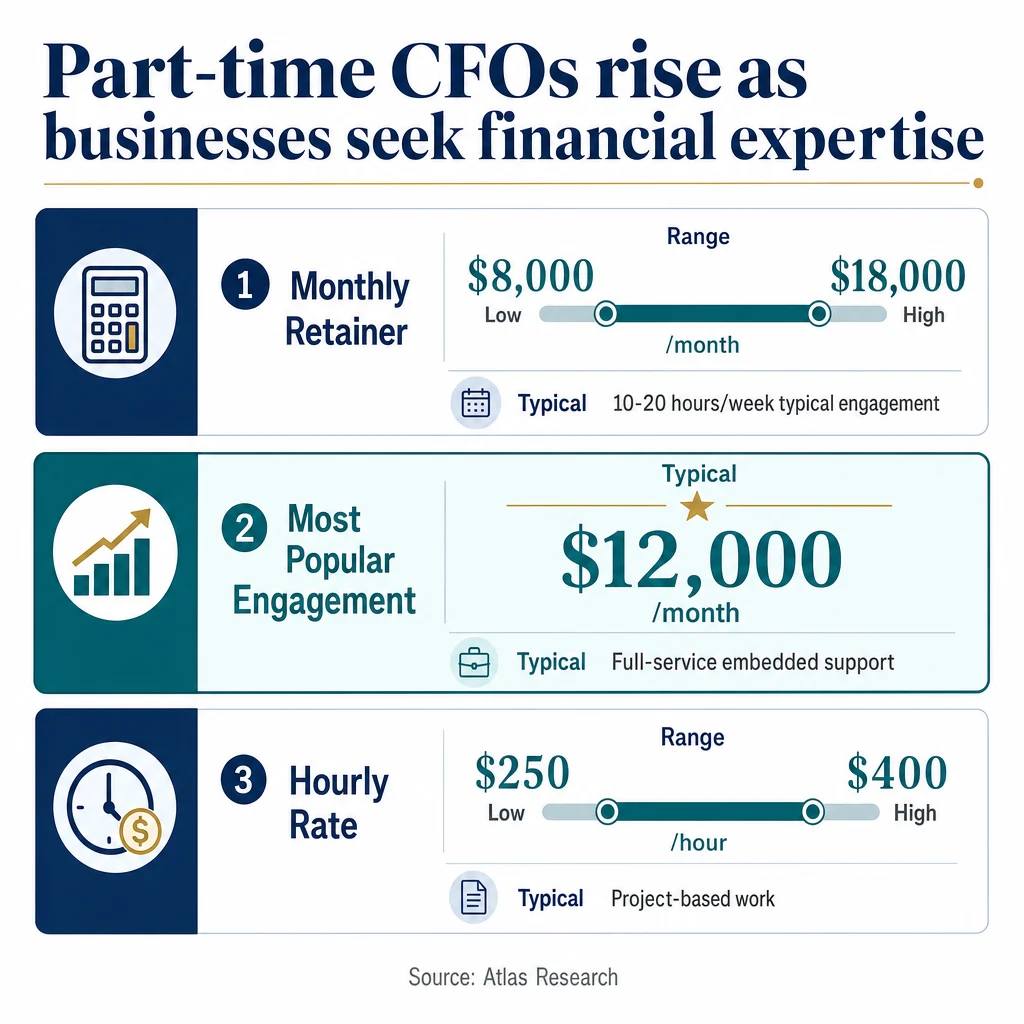
| Pricing Model | Typical Range | Notes |
|---|---|---|
| Monthly Retainer | $8,000 - $18,000/month | 10-20 hours/week typical engagement |
| Most Popular Engagement | $12,000/month | Full-service embedded support |
| Hourly Rate | $250 - $400/hour | Project-based work |
These figures represent a significant savings compared to full-time CFO compensation. FlexExec cites "30-50% cost savings vs full-time" as a primary reason companies choose the fractional model. A full-time CFO in a major metropolitan area can easily command $300,000-$500,000 in annual salary, plus benefits, equity, and bonuses. The fractional model delivers comparable expertise at a fraction of that investment.
However, it is important to understand what you are actually paying for. The monthly retainer model the most popular structure is not simply purchasing a set number of hours. It is purchasing access to senior strategic thinking, financial leadership, and executive presence. The hours are the vehicle; the value is the guidance.
As the Eightx guide notes, the typical engagement involves 8 to 30 hours per month, depending on the company's needs and the scope of the engagement. Some companies need a fractional CFO for a focused project a fundraising round, a financial system implementation, a merger while others need ongoing strategic support as they scale.
The cost also varies by platform and model. The Fractional Jobs analysis documents a range of pricing structures: "Some platforms charge nothing, others take a one-time placement fee, and some collect ongoing percentages of every dollar you pay your hire." The white-glove search services typically charge one-time fees ranging from $3,000 to $5,000, while dedicated CFO agencies operate on ongoing monthly retainers.
Understanding which pricing model aligns with your needs is a critical step in the selection process. A one-time placement fee may make sense for a specific project, while an ongoing retainer may be more appropriate for companies seeking embedded strategic support.
5. Identify the Right Moment to Bring On a Fractional CFO
Timing is everything in the fractional CFO decision. Bring one on too early, and you may be paying for expertise you haven't yet grown into. Bring one on too late, and you may be leaving money on the table or worse, making costly financial mistakes that could have been avoided.
So when should a company hire a fractional CFO? The sources consistently point to a few key inflection points.
First, when scaling rapidly. FlexExec's documentation notes that companies "typically hire fractional CFOs when they're scaling rapidly." This is the moment when financial complexity outpaces the capabilities of the existing team, and when strategic financial leadership becomes essential for sustainable growth.
Second, when preparing for fundraising. Whether it is a seed round, Series A, or later-stage capital raise, the fundraising process requires sophisticated financial modeling, investor communications, and data room preparation. A fractional CFO brings the expertise to navigate this process effectively.
Third, when navigating a transition. This could be a leadership transition (bringing in a new CEO or replacing a departing CFO), a structural transition (merger, acquisition, or sale), or a strategic transition (pivoting the business model or entering a new market). In each case, the fractional CFO provides stable financial leadership during a period of change.
Fourth, when the company needs senior expertise but isn't ready for a full-time executive hire. This is the original use case for the fractional model, and it remains highly relevant. Many companies at the $5M-$50M revenue stage have complex financial needs but don't yet require or can't yet afford a full-time CFO.
The Digital Reference guide to fractional CFO services emphasizes that "agility and financial foresight aren't just nice to have, they're survival skills" in today's business climate. The right fractional CFO doesn't just fill a gap; they help a company see around corners and plan for the financial implications of growth.
6. Distinguish Between a Fractional CFO and Other Financial Professionals
A question that often arises particularly from founders and business owners who are new to the fractional CFO concept is how a fractional CFO differs from a CPA, an accountant, or a financial consultant. This is an important distinction, and getting it wrong can lead to misaligned expectations and suboptimal outcomes.
The core difference lies in the nature of the engagement and the scope of responsibility. A CPA or accountant is typically focused on the historical record preparing financial statements, ensuring compliance, filing tax returns. Their work is backward-looking by design.
A fractional CFO, by contrast, is focused on the future. Their work involves financial strategy, forecasting, fundraising, and investor relations forward-looking activities that require not just technical financial expertise, but executive-level leadership and communication skills.
As FlexExec's service documentation makes clear, a fractional CFO "becomes part of your leadership team" and "owns outcomes and leads teams." This is fundamentally different from the project-based, deliverable-focused work of a consultant, who is brought in to solve a specific problem and then moves on.
The fractional CFO model is also distinct from the interim CFO model. An interim CFO is typically a full-time, temporary replacement for a departing or newly-created CFO position. They may work alongside the existing team or lead it directly, but their engagement is defined by the absence of a permanent hire. A fractional CFO, by contrast, is a permanent or semi-permanent addition to the team, working part-time alongside existing financial staff.
Understanding these distinctions is essential for hiring the right resource for your needs. If you need tax preparation and compliance support, a CPA is the right choice. If you need a specific financial analysis or system implementation, a consultant may be appropriate. But if you need ongoing strategic financial leadership someone who will help you plan, execute, and communicate around your company's financial direction a fractional CFO is the right fit.
7. Evaluate Platforms and Choose the Right Engagement Model
The fractional CFO market has matured to the point where companies have genuine choices in how they engage talent. Understanding the different platforms and models is essential for making an informed decision.
According to the Fractional Jobs analysis of the top platforms for 2026, the market offers five primary engagement models:
| Platform Type | Best For | Pricing Model |
|---|---|---|
| White-glove search services | Companies seeking vetted, matched talent with professional support | One-time fee ($3,000-$5,000) |
| Dedicated CFO agencies | Companies wanting embedded, ongoing fractional support | Ongoing monthly retainer |
| Marketplaces and directories | Companies comfortable self-directing their search | Free or low cost |
| Outsourced CFO + accounting firms | Companies wanting integrated financial services | Ongoing monthly retainer |
| Solo fractional CFOs | Companies seeking direct relationship with individual executive | Varies by arrangement |
Each model has its strengths. White-glove search services like Fractional Jobs offer a curated, supported experience the platform manages the vetting and matching process, and the company hires the CFO directly, owning the relationship from day one. Dedicated CFO agencies like FocusCFO or G-Squared Partners provide a more comprehensive, team-based approach, embedding not just an individual but a financial infrastructure into the client organization.
For companies that prefer a more hands-on approach, self-service directories offer direct access to fractional CFO talent without the intermediary support. These platforms are typically free or low-cost, but they require the company to manage its own vetting, negotiation, and onboarding process.
The key is to match the platform model to your company's needs, capabilities, and preferences. If you have the internal resources to manage a search process but want access to vetted talent, a directory or marketplace may be appropriate. If you prefer a supported experience with professional matching and onboarding, a white-glove search service may be a better fit. And if you want a comprehensive, embedded financial partnership, a dedicated CFO agency may be the right choice.
8. Avoid Common Mistakes Companies Make With Fractional CFO Engagements
Like any business relationship, the fractional CFO engagement can go wrong not because the model is flawed, but because of misaligned expectations, poor communication, or inadequate onboarding. Understanding the common mistakes can help you avoid them.
Mistake #1: Treating the fractional CFO as a task-doer rather than a strategic partner. If you hire a fractional CFO and immediately assign them a list of financial tasks reconciling accounts, preparing reports, processing payroll you are not using the model effectively. A fractional CFO's value lies in strategic thinking, not transactional work. If you need transactional support, hire a bookkeeper or controller. Use the fractional CFO for financial leadership.
Mistake #2: Not providing adequate access to information and leadership. A fractional CFO cannot provide strategic guidance without access to the company's financial data, leadership team, and decision-making processes. Some companies treat the fractional CFO as an outsider to be managed, rather than an embedded executive to be included. This limits the CFO's effectiveness and reduces the value of the engagement.
Mistake #3: Unclear scope and expectations. The most successful fractional CFO engagements have clear expectations around scope, availability, communication, and outcomes. Without this clarity, both parties can develop mismatched expectations, leading to frustration and suboptimal results. Take the time to define the engagement clearly at the outset.
Mistake #4: Expecting immediate results without adequate onboarding. Even the most experienced fractional CFO needs time to understand your business, your financials, your team, and your strategic priorities. Expecting immediate transformation after the first week is unrealistic. Build in adequate onboarding time and set realistic milestones for the engagement.
Mistake #5: Choosing based on cost alone. While cost savings are a legitimate benefit of the fractional model, choosing a fractional CFO based solely on the lowest price can be a false economy. Experience, specialization, cultural fit, and track record all matter. The right fractional CFO should pay for themselves through improved financial outcomes, better strategic decisions, and avoided mistakes.
9. Recognize the Long-Term Value and Strategic Impact
When evaluating whether a fractional CFO is worth the investment, it can be tempting to focus on the short-term cost. After all, $12,000 per month is real money, even if it is less than a full-time CFO's salary. But the true value of a fractional CFO lies not in the monthly fee, but in the strategic impact they deliver over time.
A skilled fractional CFO can help a company avoid costly financial mistakes, identify and capture revenue opportunities, improve cash flow management, navigate complex transactions, and communicate more effectively with investors and boards. These contributions can easily exceed the cost of the engagement many times over.
FlexExec's data on client outcomes is telling: the platform reports a 94% client satisfaction rate, with companies citing not just cost savings but improved financial visibility, better strategic planning, and more effective investor relations. These are not peripheral benefits they are core to the value proposition of the fractional CFO model.
The historical evolution of the model also suggests something about its long-term viability. What began as a workaround for cash-strapped startups has become a mainstream business practice embraced by companies across industries and stages. This is not a trend it is a structural shift in how companies think about financial leadership.
For FlexExec readers specifically, this historical context matters. The fractional CFO model is not a temporary solution or a compromise. It is a legitimate, proven approach to financial leadership that has matured significantly over the past two decades. Understanding this history can help you approach the decision with confidence, rather than skepticism.
10. Take the Next Step in Your Research
The fractional CFO model has a rich history and a clear value proposition. But the best way to understand whether it is right for your company is to dig deeper into the specifics the platforms, the pricing models, the engagement structures, and the outcomes that companies have achieved.
For a comprehensive comparison of the leading fractional CFO platforms and their pricing models, the Fractional Jobs analysis of the top 5 platforms for 2026 provides a detailed breakdown of each option's strengths and ideal use cases.
For a broader overview of the market landscape and detailed profiles of twelve leading fractional CFO firms, Shiny's guide to fractional CFO firms offers practical insights into what each firm truly offers.
For a deeper dive into the cost structure, timing considerations, and selection criteria for fractional CFO services, the Eightx 2026 guide to fractional CFO services provides a comprehensive framework for evaluation.
The fractional CFO model did not emerge overnight, and it will not disappear tomorrow. It is a durable solution to a persistent problem and for growing companies at the right inflection point, it may be exactly the strategic financial leadership they need.
Why This History Matters for FlexExec Readers
Understanding the historical evolution of fractional CFO services is not just an academic exercise. It is practical context for a real business decision. When you understand where the model came from, how it has matured, and what it has proven capable of delivering, you can approach the decision with greater clarity and confidence.
The FlexExec platform itself reflects this maturation. With its focus on matching pre-vetted fractional executives to companies in specific industries including accounting, CPA, and consulting firms the platform embodies the evolution from informal, word-of-mouth arrangements to structured, professionalized engagements. The 94% client satisfaction rate, the 15+ years of average experience among matched executives, and the 1-2 week start time are not marketing claims. They are evidence of a model that has been refined over decades.
For FlexExec readers researching fractional CFO services, this history suggests that the model is not a gamble or an experiment. It is a proven approach to financial leadership that has been validated by thousands of companies across industries and stages. The question is not whether the fractional CFO model works the evidence suggests that it does. The question is whether it is the right fit for your company, at this moment, given your specific needs and circumstances.
That is a question only you can answer. But the historical context provided here should give you the foundation to answer it well.