


Most Washington watchers expected another lockdown. When the Bureau of Industry and Security released its November 16, 2026 interim final rule, the headlines screamed about new semiconductor restrictions. But read the fine print and the direction the rule actually came from and a different story emerges. This isn't a wall. It's a door with specific keys required.
The conventional wisdom goes like this: every BIS semiconductor rule since October 2022 has tightened the noose on China's access to advanced AI chips. The October 2022 package created license requirements for high-end AI and supercomputing chips shipped to China. The October 2023 update dropped interconnect thresholds and switched to total processing performance metrics, catching Nvidia's A800 and H800. By December 2024, high-bandwidth memory joined the restricted list. Each move looked like a ratchet, one direction only.
That reading misses something important about the November 2026 rule. It was written by and at the direction of the Department of Treasury and the National Security Council not the typical export control apparatus alone. That's not the signature of a pure restriction. That's the signature of coordinated economic and foreign policy.
The Rule That Wasn't Just About Export Controls
According to the BIS press release announcing the rule, the interim final rule was specifically designed to ensure that existing restrictions on access to sensitive American technology cannot be circumvented through remote computing arrangements involving data centers in third countries.
Notice the framing: existing restrictions. The rule's primary purpose wasn't to add new chips to controlled lists. It was to close a specific loophole cloud computing arrangements that let advanced American computing capabilities be accessed remotely, including through data centers located outside countries subject to U.S. export restrictions.
The United States remains, as the announcement states, the global leader in advanced computing and super intelligence technology. The rule explicitly commits to promoting the global adoption of American technology for legitimate commercial purposes while ensuring sensitive technologies aren't exploited in ways that threaten national security.
This language matters. It's not the vocabulary of embargo. It's the vocabulary of managed integration keeping American technology at the center of global AI infrastructure while preventing circumvention.
What the Rule Actually Controls
The IFR addresses remote access to advanced super intelligence chips and servers. For data center operators, this means the rule targets the ability to access advanced computing capabilities through cloud arrangements rather than through direct purchase of hardware.
The rule further aligns protections governing remote access to advanced computing capabilities with existing controls on the physical shipment of sensitive American technology. In practical terms, if a data center in a third country is serving as a relay point to let entities in embargoed destinations access advanced SI chips remotely, that arrangement now falls under the same restrictions as physically shipping the hardware.
For operators building legitimate cloud infrastructure outside restricted destinations, this creates clarity rather than constraint. The rule doesn't restrict where data centers can operate it restricts which entities can use them as backdoors to restricted technology.
The Diplomatic Pivot: From Denial to Case-by-Case
Here's where the contrarian reading gets interesting. Just two months before the November 2026 IFR, BIS issued a separate rule on January 13, 2026 that dramatically altered the licensing landscape for physical chip exports to China.
According to the Department of Commerce announcement, BIS revised its licensing policy to review export license applications for the Nvidia H200, AMD MI325X, and similar chips on a case-by-case basis provided certain security requirements are met.
This represented a significant shift. Previously, exports of these chips to China faced a presumption of denial. The January 2026 rule moved to conditional case-by-case review, available only for exports meeting strict requirements.
Under Secretary for Industry and Security Jeffrey Kessler stated: "Export controls should evolve with changes in technology, while protecting national security. Permitting the sale of the H200 to China under controlled conditions will strengthen the American technology ecosystem."
That's not the language of an agency under siege. That's the language of confident technology leadership using export controls as precision tools rather than blunt instruments.
Three Keys to the Case-by-Case Door
The January 2026 rule established specific conditions that license applicants must demonstrate:
- The export will not reduce global semiconductor production capacity currently available to U.S. customers
- The Chinese purchaser has adopted export compliance procedures, including customer screening
- The product has undergone independent, third-party testing in the United States to verify its performance and security
These aren't rubber-stamp requirements. They establish a framework where controlled commercial relationships become possible if both buyer and seller meet verifiable standards. The rule follows President Trump's December 8, 2025 announcement that the United States would allow the H200 and similar products to be shipped to approved customers in China to strengthen national security.
The Baker McKenzie analysis of the rule notes that "AI commodities" eligible for the case-by-case licensing policy include advanced computing hardware such as the Nvidia H200, AMD MI325X, and their functional or lesser equivalents. The firm observed that the more favorable case-by-case license review policy for exports of advanced computing chips from the United States appears tied to those subject first to a 25% tariff upon import into the United States a tariff imposed by President Trump's January 15, 2026 proclamation.
This creates an interesting economic architecture: tariffs on foreign-produced chips entering the U.S., paired with case-by-case licensing pathways for controlled exports. It's not isolation. It's leverage.
Understanding the TPP Threshold Framework
For data center operators and semiconductor buyers, the technical threshold framework determines which products trigger licensing requirements. The Referently timeline tracking BIS rules since 2022 explains how these thresholds evolved.
The October 2022 package created license requirements using a mix of processing performance and chip-to-chip interconnect speed. The October 2023 update dropped the interconnect test and switched to total processing performance (TPP) and performance density catching the A800 and H800 that Nvidia had designed to slip under the original thresholds.
Nvidia's response was the H20, built to sit below the new thresholds. This pattern regulation, circumvention, refined regulation has repeated throughout the semiconductor control regime. The November 2026 IFR represents the latest refinement: closing the remote access loophole that hardware-focused thresholds couldn't address.
For operators evaluating which chips they can deploy through which channels, understanding this threshold evolution matters. The rules aren't static walls. They're dynamic systems that respond to engineering solutions designed to circumvent them.
Why This Matters for Bureau of Industry and Security Readers
If you're researching export compliance, evaluating data center infrastructure investments, or analyzing semiconductor supply chains, the November 2026 IFR and the January 2026 licensing revision together tell a specific story: Washington is building a managed access architecture rather than a blanket embargo.
The door exists. It requires specific keys: U.S. third-party testing, compliance procedures, customer screening, and demonstrated supply availability for American customers. The question for operators isn't whether to engage it's whether you can meet the requirements to walk through legitimately.
This represents an operational opportunity for compliant data center operators. While the rule tightens restrictions on circumvention routes, it clarifies pathways for legitimate deployment. If your infrastructure serves customers outside embargoed destinations and your supply chain meets testing and compliance standards, the framework becomes an asset rather than an obstacle.
The Tariff-Controls Architecture
One element often missed in coverage: the interconnection between tariff policy and export controls. The January 2026 tariff on advanced computing chips produced outside the United States 25% for chips like the H200 and MI325X passing through the U.S. before export to customers outside the U.S. paired with the case-by-case licensing pathway.
This creates a specific economic logic: chips manufactured overseas and passing through U.S. distribution face a tariff, but can qualify for favorable licensing treatment if they meet security requirements. Domestic manufacturing and controlled foreign production get different treatment under the same framework.
For data center operators, this means the rules create competitive advantages for supply chains that can demonstrate compliance and testing credentials. The 25% tariff on foreign-produced chips entering U.S. distribution channels affects cost structures but the case-by-case licensing pathway offers a route to controlled market access that wasn't available under the previous presumption-of-denial framework.
Timeline: The Regulatory Evolution
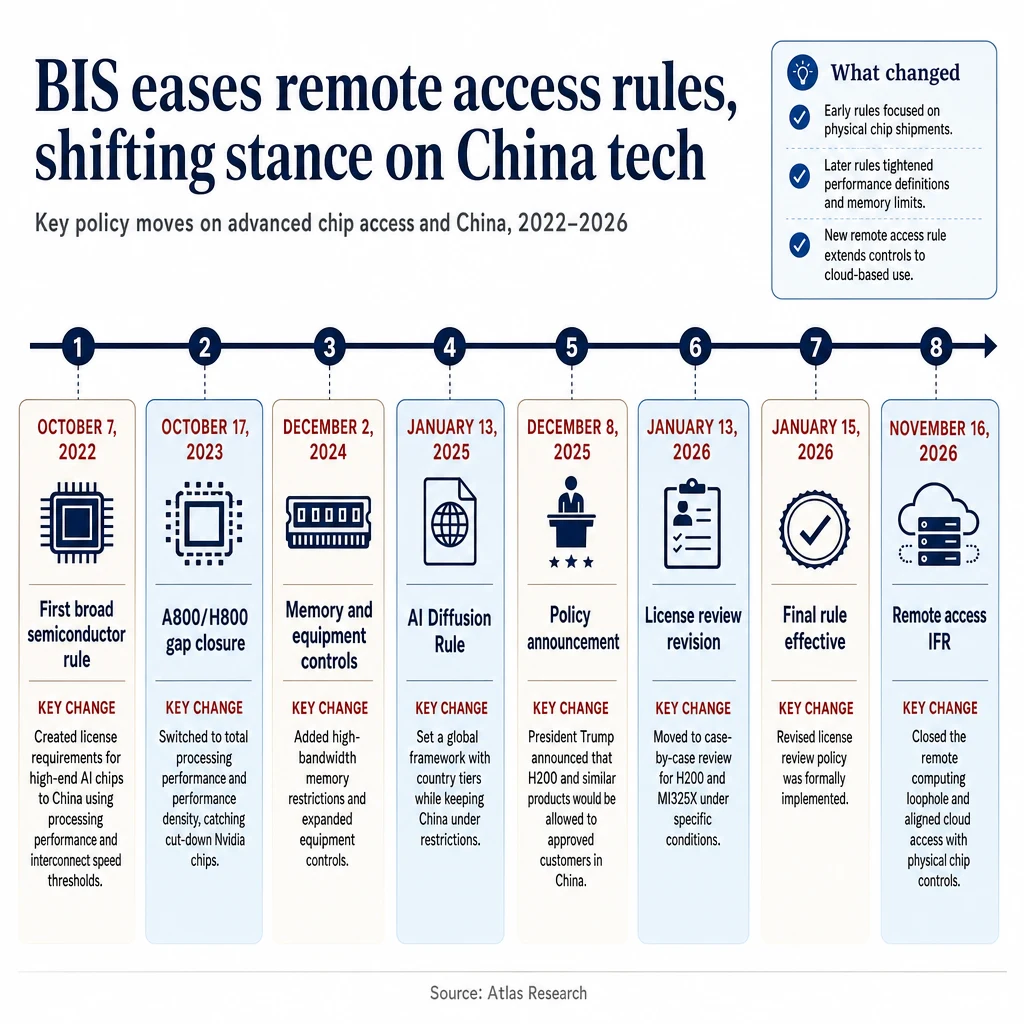
| Date | Action | Key Change |
|---|---|---|
| October 7, 2022 | First broad semiconductor rule | Created license requirements for high-end AI chips to China using processing performance and interconnect speed thresholds |
| October 17, 2023 | A800/H800 gap closure | Switched to TPP and performance density; caught cut-down Nvidia chips |
| December 2, 2024 | Memory and equipment controls | Added high-bandwidth memory restrictions; expanded equipment controls |
| January 13, 2025 | AI Diffusion Rule | Global framework with country tiers; kept China under restrictions |
| December 8, 2025 | Policy announcement | President Trump announced H200 and similar products would be allowed to approved customers in China |
| January 13, 2026 | License review revision | Moved to case-by-case review for H200, MI325X under specific conditions |
| January 15, 2026 | Final rule effective | Revised license review policy formally implemented |
| November 16, 2026 | Remote access IFR | Closed remote computing loophole; aligned cloud access with physical chip controls |
This timeline shows a pattern often overlooked in coverage focused on individual rules: the cumulative effect has been threshold refinement and circumvention closure, not simply escalation. Each rule responds to engineering solutions that found gaps in previous controls.
What Operators Should Watch
The November 2026 IFR is an interim final rule, meaning it takes effect immediately but allows for public comment. Data center operators with interests in remote computing arrangements should monitor the Federal Register for guidance on implementation and potential comment period opportunities.
The rule's alignment of remote access protections with physical shipment controls creates a more coherent framework for compliance planning. Organizations that have built compliance programs around EAR export controls will find the remote access provisions extend familiar concepts to cloud infrastructure.
The key question for most operators isn't whether the rule affects them directly it's whether their customers or supply chain partners could create circumvention pathways that trigger enforcement attention. Proactive compliance architecture protects both the operator and their customers from inadvertent violations.
Where to Read Further
For the complete text of the November 2026 rule and official background, the BIS press release on the remote access IFR provides the official announcement and links to the full text.
For the January 2026 licensing revision and the case-by-case framework, the Department of Commerce announcement includes Under Secretary Kessler's statement and links to the Federal Register.
For comprehensive context on how these rules fit the regulatory trajectory since 2022, the Referently timeline of BIS semiconductor rules tracks each major intervention with explanation of what changed and who felt it.
The Baker McKenzie analysis provides detailed examination of how the January 2026 tariff and licensing changes work together, including the specific "AI commodities" eligible for case-by-case review and the certification requirements for applicants.